Claude Fable 5.1: Pricing, Capabilities, and When to Use It Over Opus 5
Fable 5.1 is the top of Anthropic's widely released lineup: a 1M-token context window, up to 128K output tokens, and thinking that is always on. In exchange it costs twice what Opus 5 costs on the API and answers more slowly. This guide covers what you actually get, what changes in the API, and why Anthropic's own documentation still recommends starting with Opus 5.
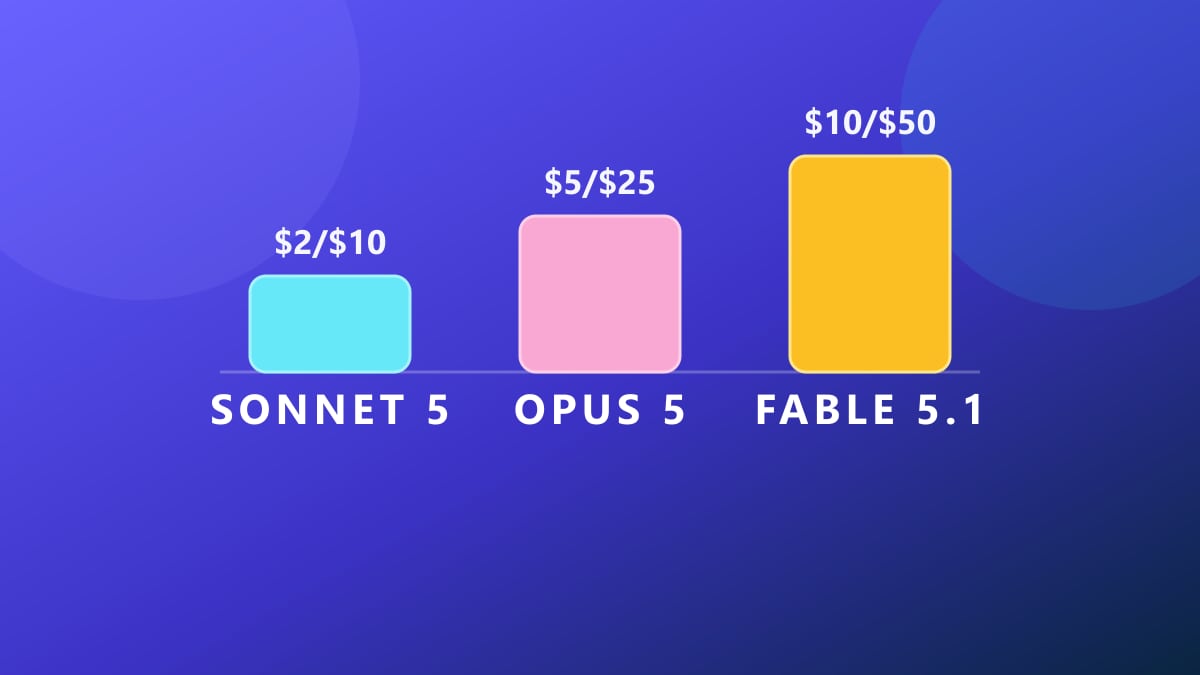
The top of Anthropic's lineup
$10 and $50 per million tokens
This article at a glance
- Fable 5.1 is Anthropic's most capable widely released model, built for demanding reasoning and long-horizon agentic work rather than everyday chat.
- It costs twice what Opus 5 costs on the API — $10 input and $50 output per million tokens — and Anthropic's own table marks it "slower".
- It is a model on the API, not the next rung of a subscription. Paying more for a plan does not necessarily get you there.
- Anthropic's own advice: start with Opus 5, and move to Fable 5.1 when Opus 5 at higher effort still falls short.
What exactly is Fable 5.1?
Anthropic ships a family of models, not one model. Fable 5.1 is the top of the widely released lineup, described by Anthropic itself as being "for demanding reasoning and long-horizon agentic work". Its Claude API ID is claude-fable-5-1.
The headline specs fit in one line: a 1M-token context window — roughly 555,000 words on the current tokenizer — up to 128K output tokens, reliable knowledge through June 2026, and thinking that, unlike other models, cannot be switched off at all.
A model is not a subscription tier
This is the most common misunderstanding about any new model. The prices in this article are API prices, billed per token — the more you send and receive, the more you pay. That is a different thing from a monthly subscription to the chat app.
Which model is open on which claude.ai plan is not a fixed number, and it is not published anywhere we can cite — that page does not answer automated requests. So we make no claim here about subscription plans. Check the available model list inside the app itself.
How it compares to the rest of the family
All prices are per million tokens, taken from Anthropic's official pricing page.
| Feature | Fable 5.1 | Opus 5 | Sonnet 5 | Haiku 4.5 |
|---|---|---|---|---|
| Claude API ID | claude-fable-5-1 | claude-opus-5 | claude-sonnet-5 | claude-haiku-4-5 |
| Input (per 1M tokens) | $10 | $5 | $2 | $1 |
| Output (per 1M tokens) | $50 | $25 | $10 | $5 |
| Cache read | $0.25 | $0.50 | $0.20 | $0.10 |
| Context window | 1M tokens | 1M tokens | 1M tokens | 200K tokens |
| Max output | 128K tokens | 128K tokens | 128K tokens | 64K tokens |
| Comparative latency | Slower | Moderate | Fast | Fastest |
| Thinking | Adaptive, always on | Adaptive | Adaptive | Extended |
| Reliable knowledge cutoff | Jun 2026 | May 2026 | Jan 2026 | Feb 2025 |
So who should actually use it?
The interesting part is that Anthropic answers this itself, and the answer is conservative: the model-selection guide says to start with Opus 5 for most workloads, and to pick up Fable 5.1 when your evals on Opus 5 at higher effort still fall short. Being the newest model is not on its own a reason to use it.
Heavy multi-step reasoning
Problems whose answer is a long chain of inference, where one mistake in the middle invalidates the whole output.
Long-horizon agentic work
An agent calling dozens of tools in sequence and holding a goal for hours, where decision quality matters more than the price of any one request.
Very long inputs
The 1M-token window is billed at the standard rate — a 900k-token request costs the same per token as a 9k-token one.
Where Opus 5 fell short
That is the practical test: try Opus 5 at higher effort first, and only reach for Fable 5.1 if your own evals still fail.
What changes in the API
If you have code running on Opus 5 today, swapping the model string is not enough. Four things return a 400 on Fable 5.1 that were accepted on earlier models.
Thinking is always on
Omit the thinking parameter entirely, or send adaptive. Both {type:"disabled"} and budget_tokens return a 400. Control depth with output_config.effort — low through max, defaulting to high.
Forced tool use is gone
tool_choice with any or tool returns a 400. Use auto plus an explicit instruction naming the tool, or strict:true on the tool definition, or structured outputs if the forced call only existed to get JSON back.
History is append-only
Thinking blocks are bound to the model that produced them, and editing earlier turns invalidates them. Your harness must append to the conversation rather than rewrite its middle.
Handle the refusal stop reason
A request can return HTTP 200 with stop_reason set to refusal. Always check stop_reason before reading content, and keep server-side fallbacks enabled in production code.
One more thing that does not show up in the code but matters in practice: the raw chain of thought is never returned. By default the thinking block arrives with empty text, and if you want to show a readable summary you must set display to summarized explicitly. Without that, your UI shows a long unexplained pause before the answer starts.
What it really costs
"Twice Opus 5" is the right starting point, but two factors move it in opposite directions, and neither is visible in the per-token price.
Against you: the tokenizer
Models from the 4.7 generation on use a newer tokenizer that produces roughly 30% more tokens for the same text. If you are migrating from Sonnet 4.6 or older, your bill rises by more than the rate difference suggests. Re-measure with the token counting endpoint.
For you: caching
A cache read on Fable 5.1 is billed at 2.5% of the input price, against 10% on every other model. That is $0.25 versus $0.50 for Opus 5 — for a workload with a long stable prompt, cache reads on the most expensive model cost less than on Opus 5.
For work that is not time-sensitive, the Batch API halves both sides: $5 input and $25 output. And the 1M-token window carries no premium — the per-token rate is flat across the whole window.
Frequently asked questions
How is Fable 5.1 different from Opus 5?
Fable 5.1 targets heavier reasoning and long-horizon agentic work, and its reliable knowledge runs to June 2026 versus May 2026 for Opus 5. In exchange it costs twice as much ($10/$50 versus $5/$25 per million input/output tokens) and is marked "slower" in Anthropic's own comparison table. Context window and max output are identical: 1M and 128K tokens.
Is Fable 5.1 available on a claude.ai subscription?
That is something we cannot confirm against a citable source. The documentation Anthropic publishes for developers covers the API and prices it per token; the consumer plan page does not answer automated requests. Check the model list inside the app itself rather than relying on this article.
Why does Anthropic itself say to start with Opus 5?
Because it is enough for most work and costs half as much. Anthropic's model-selection guidance makes Opus 5 the starting point and suggests Fable 5.1 for when your evals on Opus 5 at higher effort still fall short. The test is measurement on your real workload, not the price table.
Does it really cost twice as much as Opus 5?
The base price is exactly double, but the real cost depends on the shape of your workload. If you have a long stable prompt that gets cached, cache reads on Fable 5.1 are billed at 2.5% of the input price versus 10% on every other model — $0.25 against $0.50 for Opus 5. For non-urgent work the Batch API halves it again, to $5/$25.
Will my existing code work if I switch the model?
Not necessarily. If your code sends budget_tokens, disables thinking, sets tool_choice to any or tool, or prefills the last assistant message, all four return a 400 on Fable 5.1. Search your code for those before switching.
A Claude account, without the payment problem
Using Claude requires a foreign payment, and an Iranian card is rejected on Anthropic's checkout. Rima provides the account through a secure Iranian payment gateway at a stated price.
See the Claude accountRead next
Sources