What Is an Application Fee? Costs, Waivers and Paying From Iran
An application fee is what a university charges to review your file — not to admit you. Without it your application never enters the queue, and because it is effectively never refunded, any mistake made before you pay is an expensive one.
Applying abroad
The application fee, end to end
This article at a glance
- The application fee pays for the review, not for a place.
- Contrary to what is often said, the admission deposit is usually non-refundable too — the difference is that it is credited against your tuition.
- Fee waivers do exist for international applicants; it is worth asking.
- Paying from Iran needs an international card, so it goes through an intermediary.
What the fee actually pays for
Reviewing an application costs a university real administrative time: reading documents, assessing a CV and statement of purpose, checking records. The application fee covers that, and doubles as a filter so only serious applicants apply. Until it is paid, the file does not enter the review queue.
Application fee vs admission deposit
These two get mixed up constantly. The real difference is when they are paid and what for — not whether you get the money back:
| Application fee | Admission deposit | |
|---|---|---|
| When you pay it | Before submitting, while completing the application | After an offer, to hold your place |
| What it buys | Review of your documents, CV and statement | Confirmation of your seat on the course |
| If you are rejected | Not returned | Never charged |
| If you withdraw | Not returned | Usually not returned |
| If you enrol | Not returned | Usually credited against tuition |
One thing that is often stated backwards: the admission deposit is not “refundable”. At most universities it is non-refundable too — its advantage is that it is credited against your tuition if you enrol. Withdraw, and it is usually gone.
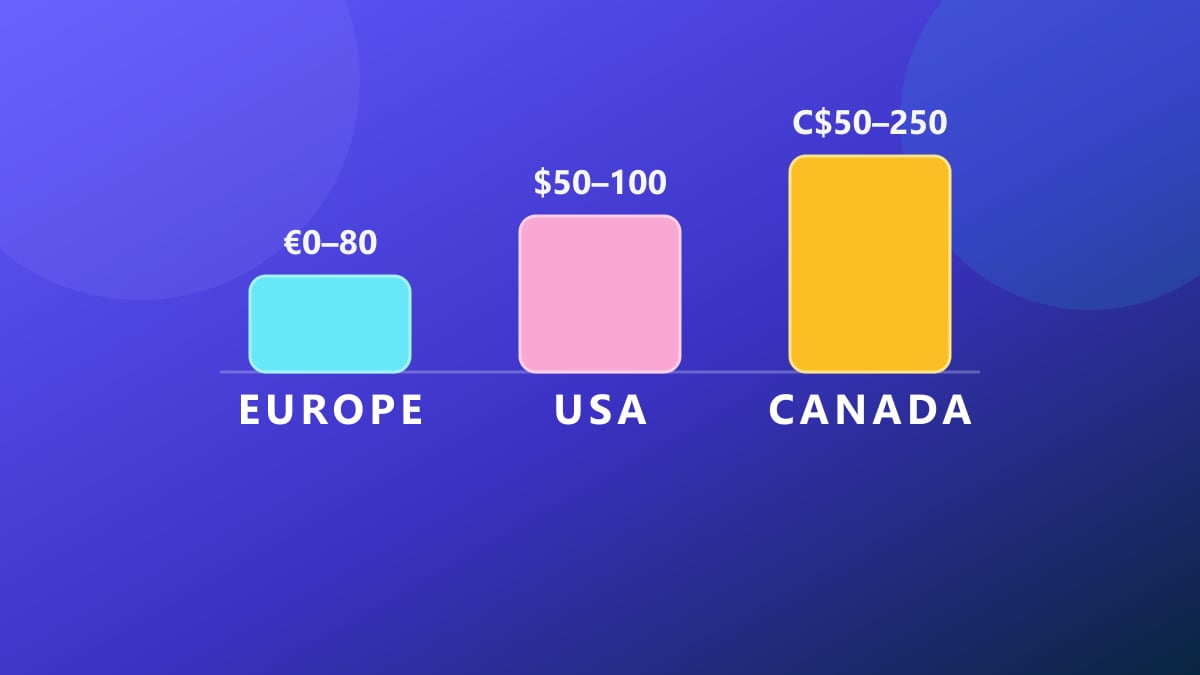
What it costs, by country
| Country | Typical range |
|---|---|
| United States | Roughly $50–100 for most programmes; competitive ones such as MBAs run higher |
| Canada | Roughly CAD 50–250 |
| United Kingdom | Undergraduate goes through UCAS at its own flat fee; postgraduate varies by university |
| Germany and parts of Europe | Many public universities charge nothing; elsewhere it is usually small |
| Australia | Roughly AUD 50–100 |
These ranges are approximate and every university sets its own — and international applicants are often charged more than domestic ones. The only number worth trusting is the one on the university's own Admission Requirements page.
Do not write off the waiver
Plenty of applicants have heard that fee waivers are only for domestic students and never ask. That is not right: some universities do extend waivers to international applicants, usually on evidence of financial need and sometimes through third-party organisations. If you are applying to several places, one email to the admissions office can save hundreds of dollars — and the worst answer you get is no.
Why paying from Iran is hard
The standard way to pay is an international credit card (Visa or Mastercard) or PayPal. Sanctions mean Iranian users have no direct access to the international banking system or those cards, and Iranian domestic cards are not accepted in university portals — so the payment has to take another route.
A currency-payment service
You pay the rial equivalent and the service settles the fee directly in the university portal from its own foreign account. The common route for Iranian applicants.
Bank transfer to the university
Some universities accept a direct transfer. It usually needs an application-specific reference number and is slower.
Someone abroad pays for you
If you know someone with an international card. Check the university's terms first: some portals expect the payer's name to match the applicant.
Paying through a service, step by step
- 1Register and verify your identity with the payment service.
- 2Submit the payment request with your university portal credentials.
- 3Pay the rial equivalent.
- 4Get the receipt, then finish submitting the application on the university's site.
- 5Keep the receipt and a screenshot until the admissions process ends.
Check these before you pay
- Check each university's exact deadline before paying — a late payment is usually not accepted.
- Have the form complete and proofread; because the fee is not returned, an error means paying again.
- Take the exact amount from the university's own Admission Requirements page, not from third-party sites.
- If you are applying to several universities, add the fees up first — the total grows quickly.
Frequently asked questions
Do I get the fee back if I am rejected?
No. It pays for the review, and the outcome of that review does not change it.
How is it different from the admission deposit?
The application fee is paid before you submit; the deposit is paid after an offer, to hold your place. Both are usually non-refundable — but the deposit is normally credited against your tuition if you enrol.
Can I get a waiver?
Possibly. Contrary to common belief, some universities extend waivers to international applicants, usually on evidence of financial need. Check the university's own admissions page or ask its admissions office.
How long before the payment shows in the portal?
It depends on the university and the method. Ask the service you use, and pay well before the deadline rather than on the last day.
Pay your application fee with Rima
You see the rial amount before you pay and receive the payment receipt afterwards. If you are not sure which route suits your university, the advice is free.
Sources